

Major Trending Topics in Farming: 5 Trends Every Farmer Should Watch
Farmers are not only dealing with the traditional challenges of planting, harvesting, livestock management and finding markets. They are also navigating climate variability, rising production costs, changing consumer demand, new technologies, water constraints and increasingly competitive agricultural markets.
At the same time, agriculture is becoming more connected to technology than ever before.
Artificial intelligence, drones, satellite imagery, smart irrigation, Internet of Things (IoT) sensors, digital marketplaces and data-driven decision-making are moving from being specialised technologies to becoming practical tools for modern farming.
For farmers in South Africa and across Africa, the important question is not simply "What technology is available?"
The more important question is:
"Which technologies and farming practices can solve real problems on my farm and improve my productivity, resilience or profitability?"
Here are five major trends shaping the future of farming.
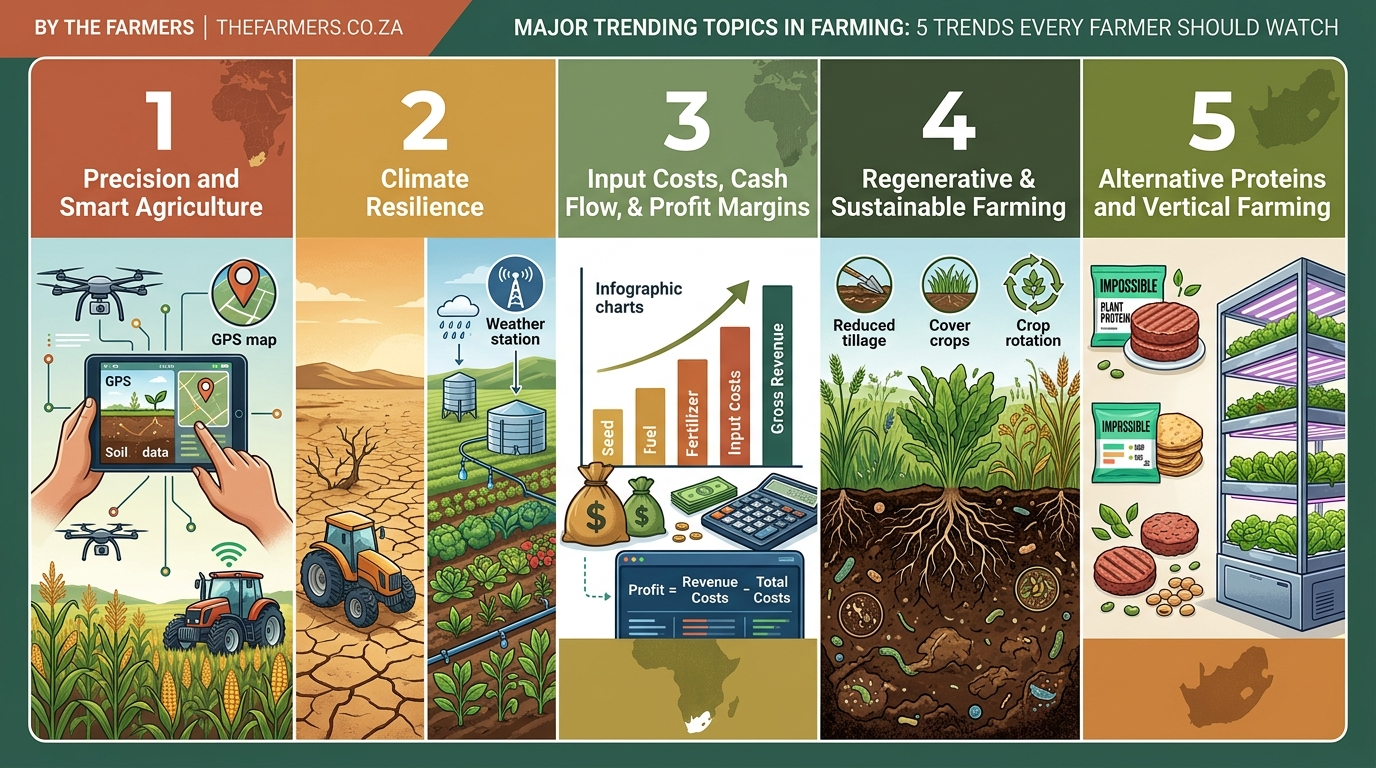
1. Precision and Smart Agriculture
One of the biggest trends in modern agriculture is the move from traditional farming based mainly on observation and experience towards data-supported farming decisions.
This is commonly known as precision agriculture or smart farming.
Precision agriculture uses technologies such as:
- Artificial intelligence (AI)
- Drones
- GPS
- Satellite imagery
- Soil sensors
- Weather stations
- IoT devices
- Automated machinery
- Variable-rate application systems
- Farm-management software
The objective is not to make farming complicated. The objective is to help farmers use resources more efficiently.
For example, instead of applying exactly the same amount of fertiliser across an entire field, data can help identify areas with different nutrient requirements.
Similarly, soil-moisture sensors can help farmers make more informed irrigation decisions, potentially reducing unnecessary water use.
GPS and auto-steer systems can improve machinery efficiency and reduce overlapping passes across fields, potentially saving fuel, time and inputs.
Drones can also provide aerial images that help farmers identify crop stress, irrigation problems or areas requiring closer inspection.
Artificial intelligence is adding another layer to this development. AI can analyse large quantities of agricultural data and assist with identifying patterns, forecasting conditions and supporting farm-management decisions.
However, farmers should not assume that buying expensive technology automatically creates better farming.
Technology must have a business case.
A farmer should calculate whether a particular system will generate enough value through increased yields, reduced waste, lower labour requirements, better resource management or reduced risk to justify its cost.
2. Climate Resilience and Changing Weather Patterns
Climate and weather remain among the biggest risks facing agriculture.
Farmers depend on conditions they cannot completely control. Drought, extreme heat, heavy rainfall, flooding, storms and changing seasonal patterns can affect crop yields, livestock and farm infrastructure.
South Africa's agricultural authorities have recognised the importance of climate adaptation, including building resilience to drought and heavy precipitation and responding to changing pest and disease risks.
Climate resilience therefore needs to become part of normal farm planning.
Farmers can consider strategies such as:
Improving soil health
Healthy soils can improve water infiltration, nutrient cycling and the ability of agricultural systems to cope with difficult conditions.
Better water management
Efficient irrigation, rainwater harvesting, water storage, leak detection and soil-moisture monitoring can all contribute to better water management.
Diversifying production
Depending entirely on one crop, market or source of income can expose a farming business to greater risk. Diversification can provide additional sources of income, although each enterprise needs to be evaluated carefully.
Choosing appropriate crop varieties
Crop selection should take local climate, soil, water availability, disease pressure and market demand into account.
Using weather information
Farmers increasingly have access to weather forecasts and agricultural climate information through digital platforms and mobile devices.
The important point is that climate resilience is not about predicting every weather event.
It is about building a farming operation that can cope with uncertainty.
Farmers should also be cautious about treating a single climate forecast as a certainty. Seasonal conditions can change, and farmers should consult reliable meteorological and agricultural sources when making major production decisions.
3. Input Costs, Cash Flow and Profit Margins
A farm can produce an excellent crop and still struggle financially.
Why?
Because farming profitability depends on the relationship between revenue and total production costs, not simply on how many tonnes are produced.
Farmers have to manage costs such as:
- Seed
- Fertiliser
- Chemicals
- Feed
- Fuel
- Electricity
- Labour
- Machinery
- Repairs
- Irrigation
- Transport
- Packaging
- Finance
- Land and infrastructure
South Africa's Department of Agriculture has documented significant movements in agricultural input expenditure over time. For example, its 2022 economic review recorded increases in expenditure on intermediate goods and services, including fertiliser, animal feed and fuel.
This is why margin management is becoming increasingly important.
Farmers need to understand not only the price they expect to receive for their products, but also the cost of producing each unit.
For example:
Profit = Revenue − Total Costs
If a farmer produces 100 tonnes of vegetables but cannot accurately calculate the cost per kilogram, it becomes difficult to determine whether the enterprise is genuinely profitable.
Market timing also matters.
Farmers may need to make decisions about when to purchase inputs and when to market their produce. Commodity prices, exchange rates, fuel prices, weather conditions and global markets can all influence agricultural economics.
Financial and market information can therefore become an important agricultural tool.
Organisations such as Absa publish agricultural market reports covering areas including livestock, vegetables, grains and oilseeds.
The lesson is simple:
Farmers need to manage the farm as both a production operation and a business.
4. Regenerative and Sustainable Farming
Another major trend is the growing focus on soil health and sustainable agricultural production.
Regenerative agriculture is generally associated with practices intended to improve soil health and ecosystem function while maintaining agricultural production.
Practices can include:
- Reduced tillage
- Cover crops
- Crop rotation
- Maintaining soil cover
- Improved grazing management
- Organic matter management
- Integrated crop and livestock systems
- More efficient use of fertiliser and other inputs
The exact approach will depend on the farming system, soil, climate and economic circumstances.
The central idea is that soil should not simply be treated as something that holds plants.
Healthy soil is an agricultural asset.
Soil organic matter, biological activity, structure and water-holding capacity can influence how a farm performs.
South African agricultural policy has also highlighted conservation and climate-smart agriculture, including approaches intended to improve environmental and financial sustainability while supporting food security.
However, regenerative agriculture should not become another farming trend that farmers adopt without measuring results.
Farmers should ask:
- Is soil quality improving?
- Is water infiltration improving?
- Are yields stable?
- Are input costs changing?
- Is profitability improving?
- Is the practice appropriate for this farm?
Sustainability needs to work environmentally and economically.
A farming practice that protects the soil but makes the business financially impossible to operate will not provide a sustainable long-term solution.
The strongest approach is to find practices that support both farm profitability and resource conservation.
5. Alternative Proteins and Vertical Farming
Food production is also changing because consumer preferences, urbanisation, technology and environmental concerns are creating new agricultural opportunities.
Two areas attracting attention are alternative proteins and controlled-environment agriculture.
Alternative proteins include products developed from plant ingredients and other technologies designed to provide alternatives to conventional animal-based protein.
The sector is developing rapidly, although its economic viability, consumer acceptance, regulation and environmental benefits vary between products and markets.
Another emerging area is controlled-environment agriculture.
This includes:
- Greenhouses
- Hydroponics
- Aeroponics
- Indoor farming
- Vertical farming
Vertical farms grow crops in stacked layers, often under controlled conditions.
Hydroponic systems can grow plants without conventional soil, while controlled environments can allow producers to manage factors such as water, nutrients, temperature and lighting.
These systems can be useful for certain high-value crops and locations where land or water availability creates constraints.
But once again, technology does not automatically mean profitability.
Electricity, infrastructure, equipment, labour, maintenance and market access can significantly affect the economics of controlled-environment agriculture.
For African farmers and entrepreneurs, the opportunity may therefore not be to copy large international vertical farms directly.
Instead, there may be opportunities to develop smaller, locally appropriate controlled farming systems based on local markets and available resources.
The Biggest Trend: Connected Agriculture
While these five trends are important individually, they become even more powerful when combined.
Imagine a farmer who uses:
Weather data + soil sensors + satellite imagery + AI + smart irrigation + digital market access.
The farmer can potentially make better decisions about:
- What to plant
- When to plant
- How much water to apply
- Where to apply fertiliser
- When to harvest
- Where to sell
- What price to target
- How to manage production costs
This is the future of connected agriculture.
And this is where digital agricultural platforms can play an important role.
The Farmers: Connecting Agriculture Digitally
Agriculture does not exist in isolation.
Farmers need buyers.
Buyers need farmers.
Agricultural businesses need customers.
Farmers need information, knowledge, services, opportunities and connections.
This is the idea behind The Farmers.
The Farmers is building a digital agricultural ecosystem where farmers, buyers, agricultural businesses and communities can connect online.
Through TheFarmers.co.za, the vision is to bring together agricultural networking, marketplace activities, farming knowledge, opportunities, jobs, education and community engagement in one digital environment.
The goal is not to tell farmers how to farm.
It is to help create an environment where farmers can connect, learn, discover opportunities and participate in the digital agricultural economy.
For South Africa and Africa, this matters because agricultural development is not only about producing more.
It is also about improving access to information, markets, technology, finance, services and networks.
What Should Farmers Do Next?
Farmers do not need to adopt every new technology they see online.
Instead, start with the problems on your farm.
If water is the biggest problem, investigate smart irrigation and soil-moisture monitoring.
If input costs are the biggest problem, improve cost tracking and input planning.
If market access is the problem, investigate digital marketplaces and direct buyer connections.
If climate risk is increasing, look at soil health, water management, crop diversification and climate information.
If labour efficiency is the problem, investigate mechanisation and automation where financially practical.
The smartest farmer is not necessarily the farmer with the most technology.
It may be the farmer who understands which technology solves which problem — and whether the numbers make sense.
The Future of Farming Is Smarter, More Resilient and More Connected
The agricultural sector is changing.
Precision agriculture is making farming more data-driven. Climate-smart practices are helping farmers prepare for environmental uncertainty. Better financial management can protect margins. Regenerative approaches are putting greater emphasis on soil health. Controlled-environment agriculture and alternative proteins are opening new possibilities.
But the foundation remains the same:
Farmers need productive farms, reliable markets and profitable businesses.
Technology should support those objectives.
The future of agriculture will not be built by technology companies alone. It will be built through collaboration between farmers, agricultural businesses, researchers, governments, financial institutions, technology developers and communities.
And farmers must remain at the centre of that transformation.
The future of farming is not simply about farming with more technology.
It is about farming smarter.
🌱 Join the agricultural community
Connect with farmers, businesses, buyers and agricultural communities through The Farmers.
The Farmers — Grow Together. Trade Better.

 Turkish
 English
 Arabic
 French
 Spanish
 Portuguese
 Deutsch
 Dutch
Dutch
 Italiano
 Russian
 Romaian
 Portuguese (Brazil)
 Greek
Greek