

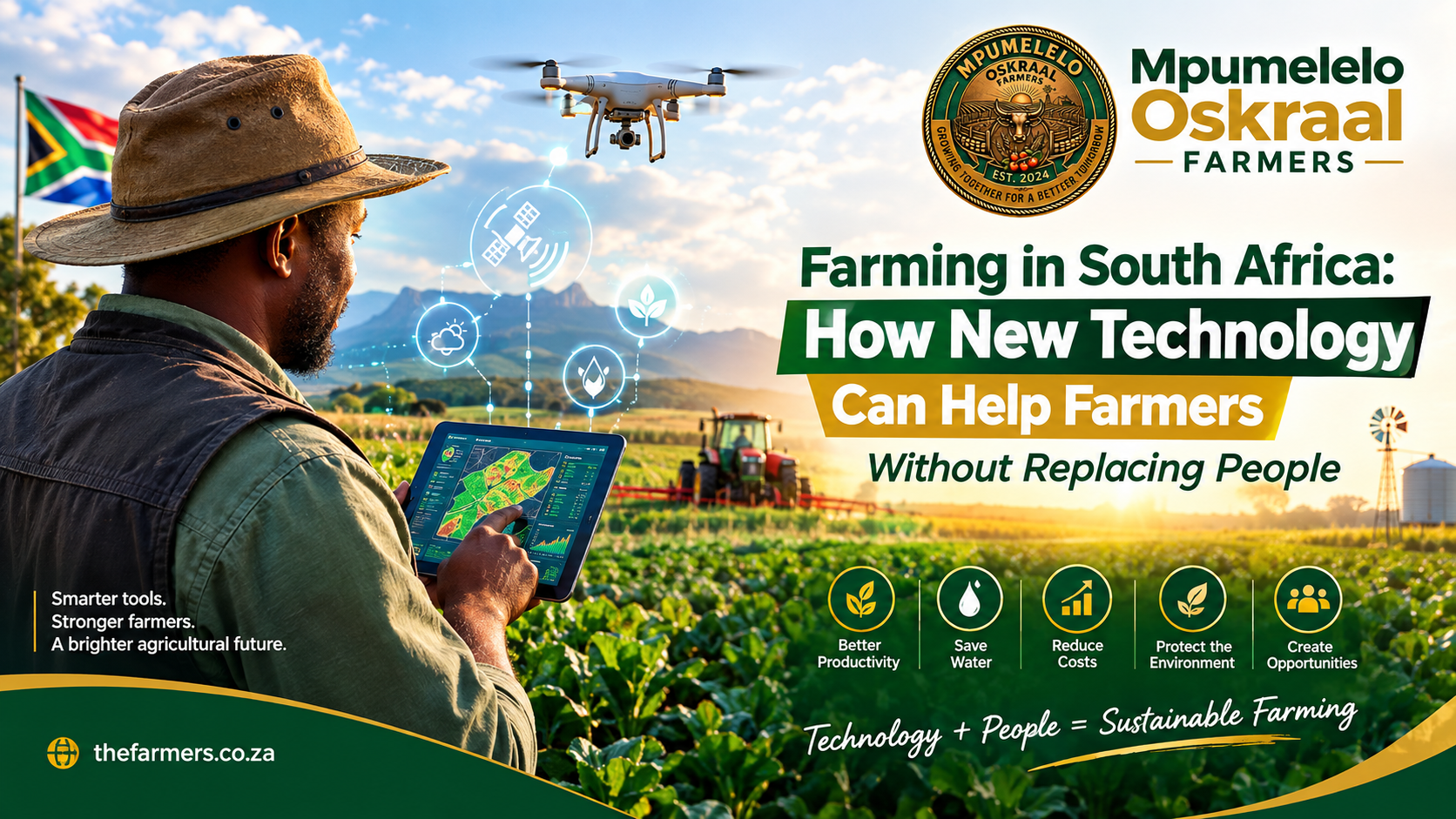
Farming in South Africa: How New Technology Can Help Farmers Without Replacing People
SEO Title: Farming in South Africa: Using New Technology Without Replacing Farmers
Meta Description: Discover how AI, drones, smart irrigation, sensors, satellite data and digital platforms can help South African farmers increase productivity while keeping people at the centre of agriculture.
Suggested URL Slug: farming-in-south-africa-new-technology
Primary Keyword: farming in South Africa
Secondary Keywords: smart farming South Africa, agricultural technology, precision farming, AI in agriculture, digital farming, South African farmers, farming technology
Farming in South Africa Is Entering a New Technological Era
Farming in South Africa is changing. Farmers are dealing with rising input costs, water shortages, unpredictable weather, pests, diseases, market pressure and the need to produce more food efficiently.
At the same time, technology is becoming increasingly accessible.
Drones, satellite imagery, soil sensors, GPS equipment, artificial intelligence (AI), mobile applications, digital marketplaces and smart irrigation systems can give farmers information that was difficult or expensive to obtain in the past.
But there is an important principle that should guide this transformation:
Technology should support farmers, not replace farmers.
Agriculture is fundamentally a human activity. Farmers understand their land, livestock, crops, communities and local conditions. Technology can provide additional information and tools, but people should remain responsible for decisions, supervision, relationships and practical work.
South Africa's Department of Science, Technology and Innovation has specifically identified technologies such as precision agriculture, robotics and information and communication technologies as important to modernising agriculture and improving productivity and sustainability.
The question is therefore not whether technology should replace farmers. The better question is:
How can technology make farmers more productive, better informed and more resilient?
1. Smart Irrigation Can Help Farmers Save Water
Water is one of the biggest challenges facing farming in South Africa.
South Africa is a water-scarce country, and agriculture is a major user of available water resources. The Department of Forestry, Fisheries and the Environment highlights smart, water-efficient irrigation as an important part of using water more effectively in agriculture.
Traditional irrigation can sometimes apply the same amount of water across an entire field, even when different parts of the field have different moisture levels.
Smart irrigation changes this approach.
Farmers can use:
- Soil-moisture sensors
- Automated irrigation controllers
- Weather information
- Drip irrigation
- Flow meters
- Water-level sensors
- Mobile monitoring systems
For example, a farmer growing tomatoes could install soil-moisture sensors in different parts of a field. Instead of irrigating simply according to a fixed schedule, the farmer can use sensor information alongside crop knowledge and weather forecasts to determine when irrigation is needed.
The farmer remains in control.
The technology simply provides better information.
South Africa's government has also encouraged farmers to use water-saving practices such as water harvesting and efficient irrigation, particularly as climate conditions create additional risks.
2. Drones Can Give Farmers a Better View of Their Fields
A farmer cannot always physically inspect every part of a large farm every day.
This is where drones can become useful.
Agricultural drones can capture aerial images that help farmers identify areas requiring attention. Depending on the equipment and software, aerial imagery can assist with identifying crop stress, irrigation problems, pest damage and differences in plant growth.
Imagine a farmer with 50 hectares of crops.
Walking through every hectare regularly could take considerable time. A drone can provide an aerial overview, allowing the farmer or agricultural technician to identify areas that deserve closer inspection.
But the drone should not make the final decision.
A better workflow is:
Drone detects → farmer investigates → farmer decides → farm team acts.
This preserves human expertise while using technology to improve efficiency.
Recent South African government information has highlighted drone-based pest scouting and other technology-assisted farming practices as examples of modern agricultural methods.
3. Artificial Intelligence Can Assist Farmers
Artificial intelligence is becoming one of the most discussed technologies in agriculture.
AI can process large amounts of information much faster than a person can manually analyse it.
For agriculture, this could include information about:
- Weather
- Soil conditions
- Crop growth
- Irrigation
- Pest activity
- Market prices
- Production records
- Livestock
- Farm finances
For example, an AI system could analyse farm records and alert a farmer that a particular field is showing unusual changes compared with previous seasons.
That does not mean the AI knows the farm better than the farmer.
It means the farmer has another source of information.
This distinction is important.
AI should function as a decision-support tool, not as the farmer.
A farmer can reject an AI recommendation because they know something the system does not—for example, a local disease pattern, soil condition, machinery problem or community issue.
Human judgement remains essential.
4. Satellite Technology Can Monitor Farms From Above
Satellite technology is another powerful tool for modern farming in South Africa.
Satellite imagery can provide information about vegetation, field conditions, weather and changes occurring over time.
This can be especially useful for farmers managing larger areas of land.
Instead of waiting until crop problems become visually obvious, farmers can use satellite information to identify unusual areas and investigate them earlier.
The South African System of Systems for Agricultural Modernisation (SASSAM), supported through the Department of Science, Technology and Innovation, is designed to provide farmers with climate intelligence, spatial data and digital decision-support tools.
This demonstrates an important direction for agriculture:
better information → better decisions → better use of resources.
5. Technology Can Help Smallholder Farmers Too
Smart farming should not become something available only to large commercial farms.
South Africa has thousands of smallholder and emerging farmers who can also benefit from affordable technology.
A farmer does not necessarily need an expensive autonomous tractor or advanced robotics system to start.
Technology can begin with something as simple as:
- A smartphone
- WhatsApp communication
- Digital weather information
- Farm-management applications
- Electronic record keeping
- Online agricultural education
- Digital marketplaces
- Mobile banking
- GPS mapping
The goal should be appropriate technology.
A R100,000 system that does not solve a farmer's actual problem may be less useful than a simple R1,000 solution that helps manage irrigation, records or market information.
Farmers should therefore ask:
What problem am I solving?
Before asking:
What technology should I buy?
6. Technology Can Create More Agricultural Jobs
One of the biggest misunderstandings about agricultural technology is that technology automatically means fewer people.
That is not necessarily the case.
Technology creates new skills and occupations.
Modern farms may need people who can work with:
- Agricultural drones
- GPS systems
- Sensors
- Irrigation equipment
- Farm-management software
- Data analysis
- Agricultural cybersecurity
- Machinery maintenance
- Digital marketing
- E-commerce
- Renewable energy
- Agricultural logistics
South Africa's Department of Agriculture has also highlighted pathways for young people into areas including agri-tech, data systems, veterinary science, extension services and agricultural learning.
This means technology can become a bridge between agriculture and the digital economy.
A young person who might never have considered farming could enter agriculture through technology.
7. Farmers Still Need Human Knowledge
Technology cannot replace everything that happens on a farm.
A farmer still needs to understand the land.
Someone must inspect crops physically.
Someone must care for animals.
Someone must repair equipment.
Someone must manage workers.
Someone must negotiate with buyers.
Someone must understand the local community.
Someone must make difficult decisions when conditions change unexpectedly.
Technology can tell a farmer that a field may be experiencing stress.
But the farmer still needs to determine why.
Is it water?
Disease?
Pests?
Poor soil?
Fertiliser?
Machinery?
Weather?
Or something completely different?
This is why the future of farming should not be humans versus technology.
It should be:
Humans + technology.
8. Digital Platforms Can Connect Farmers With Markets
Technology is also changing how farmers can communicate and access opportunities.
Digital agricultural platforms can connect farmers with buyers, suppliers, agricultural businesses, educators, workers and other farmers.
This is particularly important because producing food is only one part of farming.
A farmer also needs access to:
Inputs → Production → Knowledge → Finance → Logistics → Markets → Customers
A digital agricultural ecosystem can help connect these different parts.
Platforms such as The Farmers can support this approach by bringing agricultural networking, marketplace activities, farming knowledge, jobs, education, funding opportunities and community engagement together in one digital environment.
The objective should not be to turn farming into a purely digital activity.
Instead, technology should make it easier for real farmers and agricultural businesses to find one another and work together.
9. Climate Change Makes Agricultural Technology More Important
South African farmers are increasingly required to manage climate-related risks.
Government information published in September 2026 warned of El Niño conditions continuing through the 2026/27 summer season, with risks including below-normal rainfall and high temperatures in affected areas. Farmers were encouraged to implement climate-smart practices, conserve soil moisture and use water efficiently.
Technology can contribute to this adaptation.
Weather monitoring can help farmers prepare.
Soil sensors can help monitor moisture.
Satellite information can identify stressed areas.
Smart irrigation can improve water management.
Digital records can help farmers compare seasons.
AI can assist with analysing complex information.
But technology is only one part of climate resilience. Soil management, crop selection, conservation agriculture, water harvesting, good farming practices and human experience remain critical. South African environmental guidance identifies improved water management, monitoring, early warning and decision-support systems among important adaptation approaches.
10. The Future of Farming Is Human-Centred Technology
The future farmer will not necessarily be a person sitting behind a computer while machines do everything.
A more realistic future is a farmer using technology as an additional set of tools.
A farmer may walk through a tomato field while checking information on a smartphone.
A drone may scan the field.
A sensor may measure soil moisture.
A weather system may provide a forecast.
AI may highlight unusual crop conditions.
A digital marketplace may connect the farmer with buyers.
But the farmer remains the person bringing all that information together.
That is the model South Africa should pursue:
technology that strengthens people rather than removes them.
Agriculture remains an industry built around people, communities, knowledge and physical work.
Technology should make those people more capable.
Conclusion: Technology Should Empower South African Farmers
Farming in South Africa has a major opportunity to combine traditional agricultural knowledge with modern technology.
Precision agriculture, drones, satellite imagery, AI, smart irrigation, sensors and digital platforms can help farmers make better-informed decisions and use resources more efficiently.
But technology should never be treated as a replacement for the farmer.
The strongest agricultural model is one where farmers remain decision-makers while technology becomes their assistant.
The future could look like this:
A farmer with better information.
A worker with better tools.
A young person with new agricultural skills.
A smallholder with access to digital markets.
A commercial farmer using resources more efficiently.
A community connected through technology.
South Africa does not need to choose between traditional farming and modern technology.
It can combine both.
The farmer provides the knowledge, judgement, experience and human connection. Technology provides information, speed, precision and additional tools. Together, they can help build a more productive, resilient and connected agricultural sector.
Grow smarter. Work together. Keep people at the centre of farming.
Suggested CTA for The Farmers:
Join The Farmers and connect with farmers, buyers, agricultural businesses and opportunities across South Africa through one growing agricultural digital ecosystem.
References: This article draws on information from the South African Department of Science, Technology and Innovation, Council for Scientific and Industrial Research (CSIR), Department of Agriculture, Department of Forestry, Fisheries and the Environment, South African Government, and peer-reviewed research on agricultural technology.
References
- Department of Science, Technology and Innovation (DSTI) — Modernising Agriculture in South Africa Is Key to a Sustainable Future Covers the role of precision agriculture, robotics, ICT and sustainable technologies in modernising South African agricul
- SIR — Precision Agriculture Explains South African work using drones, satellite data, sensors, AI and data analytics to support farmers' decision-making.
- South African Government — Agriculture and El Niño Weather/Climate Provides current guidance on climate-smart agriculture, water conservation, irrigation and agricultural risk reduction for the 2026/27 season.
- Department of Forestry, Fisheries and the Environment — Farming and Food: Green Careers Discusses South Africa's water scarcity and the role of smart, water-efficient irrigation in agriculture
- outh African Journal of Information Management — Smart Irrigation Technologies Research examining South African small-scale farmers' perceptions and adoption of smart irrigation technology.
- Department of Agriculture — Water Use & Irrigation Development Provides information on agricultural water conservation, irrigation development and water-use management in South Africa


 English
 Arabic
 French
 Spanish
 Portuguese
 Deutsch
 Turkish
 Dutch
Dutch
 Italiano
 Russian
 Romaian
 Portuguese (Brazil)
 Greek
Greek